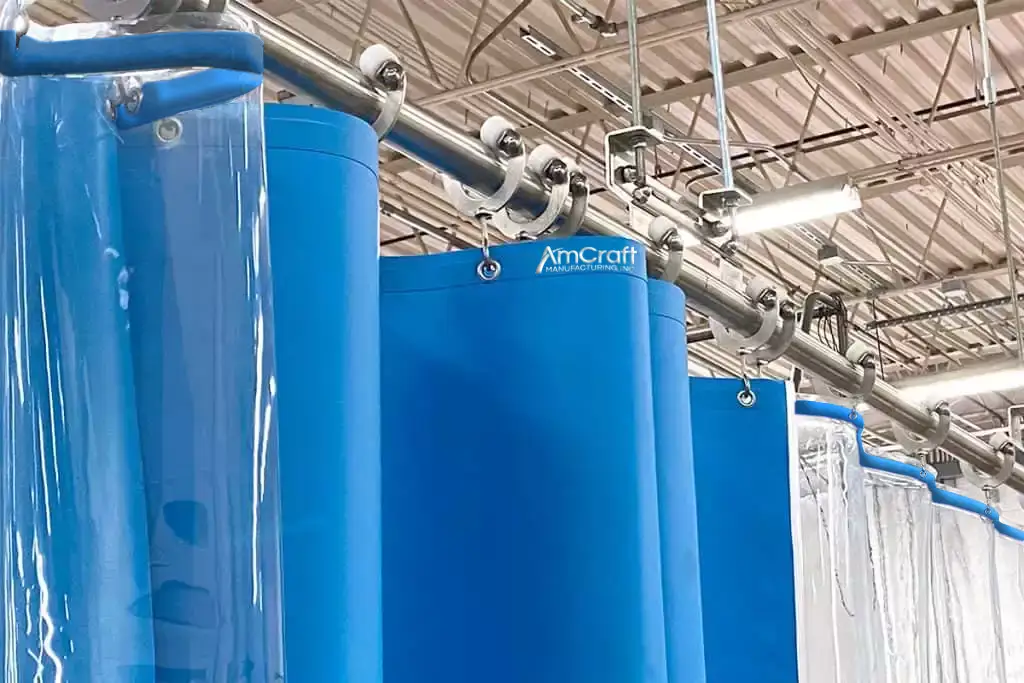
Why Do You Need an Aluminum Body Shop Enclosure?

Why Do You Need an Aluminum Body Shop Enclosure?

When it comes to auto body work within a shop, it’s not uncommon for multiple projects to be going on at once. For that reason, many facilities opt to install vinyl curtains to keep things like chemical vapor, dust and dirt, paint, and other debris from contaminating different workspaces. When you’re working with aluminum parts or vehicles, it’s important to keep the debris and contaminants away from that particular metal, as contact can have many adverse affects. CAFE requires changes in procedures for body shop workstations, so if you’ve just begun working with aluminum in your workshop, consider these reasons for why you might need an aluminum body shop enclosure.

Preventing Hazardous Contamination

Common vehicle metals, such as steel, may contaminate aluminum, and rust can be expelled when grinding or sanding steel. If rust is being ground off and gets into the air supply within a workspace and comes into contact with aluminum equipment or vehicle parts, it can bond with the aluminum and negatively affect structural integrity. Additionally, rust can hinder paint adherence if it bonds with aluminum, so every effort to keep the two separate should be made. Another reason metals often need to be kept separate is because some metals, such as iron oxide, aluminum, and magnesium, can present a hazardous environment when mixed together.

Mini Form

Additional Safety

Using aluminum body shop enclosures can also help ensure safety within aluminum car repair workspaces. In addition to existing enclosure regulations, aluminum car repair enclosures are required to adhere to combustible dust and toxic metal programs to ensure optimal safety conditions within. Typically, aluminum enclosures become necessary in shops when shops become aluminum-capable, or in other words, when an auto body shop adds new services that cater to aluminum materials.

Additional Benefits of Using an Enclosure

Some benefits of using aluminum enclosures in your auto body shop include sealing edges off to enclose one job’s debris, dust, and other particles, as well as having optional pass-through strip doors for easy access points. There are retractable and stationary styles available, ideal for creating temporary workspaces within a shop.
Best Placement for Aluminum Enclosures

When installing aluminum enclosures in your auto body shop, the placement is something you’ll need to consider for optimal efficiency. In order to minimize the amount of contamination with other projects, particularly steel body work, the aluminum enclosure should be closest to the paint/primer areas, and as far away from the other metals workspaces as possible. This helps ensure that the amount of cross-contamination is kept at a minimum.

For more information about creating aluminum body shop enclosures in accordance with CAFE implementation, or to build a body shop curtain wall, contact AmCraft today. We’ll be happy to answer any of your questions and address all of your concerns. Where you should install aluminum enclosures will, of course, depend on the size of your workspace and the type of work you do within your facility.
contact AmCraft today.

Commercial Restaurant Curtains vs. Decorative Curtains

Commercial Restaurant Curtains vs.
Decorative Curtains

Find out how Decorative vs. Industrial Restaurant Curtains bridge the divide when a decorative room divider solution is attained for a restaurant from an industrial application.

Businesses usually know where to go to purchase standard products that are used within their industry. When a new need presents itself, a business owner will look to suppliers in their industry first. However, sometimes there is a need these suppliers can’t meet. A restaurant room divider curtain falls into many industry categories that include commercial draperies, home goods, custom designers as well as restaurant equipment suppliers. Because it can be very loud in the restaurant, retractable acoustic sound barrier curtains are just a sample which most likely cannot be supplied by a restaurant supplier. In the case of Ravinia, an outdoor musical and theater venue in Highland Park, IL, their indoor restaurant was in need of a large, decorative, and retractable curtain to separate space in the banquet room. The banquet room Mirabelle, is professionally decorated and the new room divider curtain needed to look attractive and fit with the decor.

Acoustic solutions baffle sound panels restaurant
Mini Form

Looking Outside The Normal Distribution Channels

Jim R., the facilities manager for Ravinia was tasked to find a solution for concealing a large storage area inside the room. He determined early on that the best way to do this was with a retractable fabric curtain that would need to be structurally mounted to the ceiling beams.

He had the perfect, quality material for making the curtains, but no way to mount it to the ceiling. His calls to existing vendors did not produce a good option for hanging the curtain, and he had another problem. The decorative material of the curtain was semi-transparent when used with the existing lighting on either side of the curtain. He looked for a way to not only add a liner to the material, but also for a way to support the weight of the finished curtains. At this point he decided to perform some internet research to find other options.

Don’t Give Up, Instead, Think Creatively

When used inside a quality banquet facility such as the Mirabelle, the curtains need to meet the requirements of fashionable and modern décor. Industrial curtains are typically constructed of vinyl, as they are used for purposes required inside manufacturing plants, factories, warehouses and work shop type situations. Although using an industrial curtain was not an option, the method used to mount the large curtain wall looked promising.

A Track System Used As Great Design

Jim called AmCraft and found that he could indeed use a steel structural track to mount the curtains. But, the track is fabricated from polished steel and is industrial looking in appearance. AmCraft provided an option to powder coat the steel track to make the color better blend with the existing pipes and beams on the ceiling. This solution solved the appearance issue and provided a way to support the weight of large retractable curtains. The structural mounting system with a color change was perfect!

Custom Sewn Curtains From Supplied Material

Jim supplied the decorative curtain material to AmCraft and a nylon liner was sewn to it, making it opaque, but still lightweight. The decorative material was sewn to the nylon with double side hems, which created a more rigid curtain that allowed it to hang smoother and more evenly. It also eliminated the transparency of the decorative curtain material.

The combination of the two textile materials produced a high-quality, decorative curtain that is not only beautiful, but also durable enough for everyday use.

A Beautiful Outcome

Reaching out to vendors outside of your industry makes you realize there are many ways to get what you need. AmCraft enjoyed working with Jim to determine the best fabric, mounting option and construction method for the creation of a this decorative, yet industrial solution to his needs.

If you need ideas for restaurant curtains or help in dividing areas for any type of space, call AmCraft Manufacturing for custom curtain solutions at 847-439-4565 or visit our website www.amcraftindustrialcurtainwall.com

Three Ways Industrial Wall Curtains Improve Work Conditions for Employees

Three Ways Industrial Wall Curtains Improve Work Conditions for Employees

No matter what type of facility you work at, you are bound to run into questions and issues about the acoustic quality of your space. Each space, from restaurants to warehouses, is made up of different building materials that will add to or detract from the acoustic quality of your facility. Just from a cursory look at the internet, there are a number of products that boast being able to cut down on sound in a space, reduce echo, and possibly even deaden the unwanted sounds all together.

Acoustic curtains are one genre of acoustic abatement supply that are popular and for good reason. Acoustic curtain products have two main benefits. First, they can provide more space flexibility and versatility than a hard wall can. Acoustic curtains can often be moved easily and therefore can provide acoustic abatement when needed, but do not have to remain in use when they are not required. Second, acoustic industrial curtains can offer different looks and aesthetic options, which may make them more desirable for your space, depending on the setting.

However, even within the acoustic curtain category, there are many different brands and options for an acoustic industrial curtain. Before deciding which products are best for your needs, it is important to educate yourself on what measurements are used to determine how one brand of acoustic curtain compares to another.

Retractable folded curtain slider
Mini Form

The Importance of the STC Rating with Acoustic Curtains

One measure of acoustic property is the STC rating. STC stands for sound transmission class, and is defined as how well a septum, in this case an industrial acoustic curtain, can abate sound. It also tells us roughly by how many decibels a given barrier can be expected to lessen sound as the sound travels through it. While it is enticing to think that a thin fabric curtain can give a good STC rating, from a practical standpoint that isn’t realistic. A thicker curtain, one with more acoustic material inside of it, will typically have a better STC rating than a thin curtain.

A great example are the industrial acoustic curtain products offered at AmCraft Manufacturing. AmCraft manufactures acoustic curtains and panels with single block technology as well as double block technology. The acoustic insulated curtain with single block technology has an STC rating of 34.5, while the industrial curtain wall with double barrier technology boasts an STC rating of 47.5.

As a comparison, a single layer of 1/2″ drywall on each side, wood studs, no insulation (typical interior wall) has an STC rating of about 33- comparable to AmCraft’s single barrier acoustic curtain. Meanwhile, 6″ Hollow CMU (Concrete Masonry Unit) has a typical STC rating of about 46, which is slightly less than AmCraft’s double barrier technology curtain.

How NRC Rating Factors into Noise Absorbing Curtains

In addition to considering the STC rating of an acoustic curtain product, you should also consider the NRC rating. NRC stands for noise reduction coefficient, and is an indication of the amount of sound absorbed when it hits a particular surface. An NRC rating of 0 indicates total reflection of the sound, while an NRC rating of 1 indicates total absorption of the sound. As it relates to AmCraft Manufacturing’s product offering, their acoustic curtain with single barrier technology offers an NRC rating of 0.82 and the acoustic curtain with double barrier technology brags an NRC rating of 0.64. Both options offer a superior NRC rating to many of the other curtain products that are readily available.

In your search for the perfect acoustic product, you will find AmCraft’s acoustic industrial curtain wall and acoustic panel products are designed to fit your needs. These curtains offer superior acoustic value, as illustrated by their STC and NRC ratings. They are also fully customizable to your size and aesthetic requirements and are available in both retractable and stationary options.

How Can You Use Industrial Wall Curtains to Save Energy and Money?

How Can You Use Industrial Wall Curtains to Save Energy and Money?

If you work in a factory or other large building, chances are you’re always looking for ways to cut operating costs. One way to do so is by saving energy on heating and cooling. If your workspace is located in an area where winter and summer temperatures are often referred to as “extreme,” then even opening a door to take trash out or accept a delivery can have a serious impact on your heating and cooling costs. Aside from simple enclosures within your workspace, there are ways that you can use industrial wall curtains to save on energy costs.

Around the Trash Compactor

This may seem nearly frivolous, but think about how many times your employees venture outdoors to throw away garbage, get rid of boxes, or dispose of materials. Even if the doors are only open for a few seconds every time, if the weather outside is humid or hot, that air is getting sucked into your building, causing the cooling systems to work overtime to bring the temperature back to normal. The same can be said for opening the space up during the winter. If you’re paying to heat the inside, introducing much colder air will only cause the heater to work harder to keep up. Instead of putting your building at the mercy of your employees’ swift exit and reentry, consider enclosing the area surrounding the platform of the compactor or dumpsters – not enclosing the trash compactors or dumpsters within the building, just installing curtain walls outside the exterior doors to limit the amount of temperature change that happens when employees take out trash. This is an effective method for saving on energy costs.

Areas That Require Higher or Lower Temperatures

If you’re adjusting your entire building’s temperatures to keep up with the needs of one specific project, you could be wasting a lot of money on heating or cooling the building when an industrial curtain wall could contain the area that needs to be a different temperature. The same can be said for areas that need higher or lower humidity. Enclosing these project spaces with retractable curtains allows you to have greater control over your heating and cooling costs, while simultaneously giving the employees who are working on these types of projects a designated area to work and contain their progress.

Mini Form

Delivery & Loading Docks

A similar situation to the trash compactor and dumpster issue, delivery and loading docks can be spaces that let a lot of heat and cold into the building in just a short amount of time. Even if a delivery or loading job only takes five minutes, and the trucks are backed up to the dock, there is still a good amount of external air that can seep into the building and cause your systems to work hard to get the temperature back to what it needs to be. Installing curtain walls outside your building’s loading and delivery docks can give your trucks’ beds a secure, weather-guarded solution for loading and unloading, which is not only energy efficient but ideal for employees as well, if it is storming outside—this way, they can stay under the enclosure to help load and unload shipments.

If you’ve been trying to think of ways to lower your energy costs, look around your workspace and consider whether there might be areas that could benefit from using industrial curtain walls. For more information about them, contact AmCraft today.

Three Benefits of Using Retractable Curtain Walls

Three Benefits of Using Retractable Curtain Walls

If you’re considering installing industrial curtain walls in your workspace, you’ve likely already researched their benefits and functions and know what they can add to your space. They’re non-permanent which makes them an ideal choice for areas that may shift in functionality with time, and they allow larger spaces to be sectioned off for different departments or jobs. Past the somewhat more obvious benefits of simply having industrial curtains, the fact that they are retractable can offer its own set of benefits.

Safety

A lot of the industries that use curtain walls perform jobs that are either messy, loud, dangerous, or some combination of all three. Installing retractable curtain walls can add a level of safety that standard walls can’t offer. For example, the areas surrounding the curtain-enclosed can become contaminated with the materials used within—chemicals, oils, and other matter that may cause problems with not only cleanliness but also employees’ respiratory systems. Particles can get in the air and into people’s lungs, but even less serious complications with airborne particles, like contaminating other projects or getting equipment dirty, can be mitigated with retractable curtains. They also offer the potential for ventilation if necessary, since they can be immediately pulled back.

Privacy for Classified Projects

Some of your business’ projects may require privacy or secrecy, and if you work on them out in the open while ever having visitors to your workplace, there’s always the risk of your projects being seen, copied, or stolen. Retractable industrial curtains give you not only the safety you need within the space you’re working on your project, but also privacy. Keep those secret projects behind closed doors, so to speak. Because the curtains are retractable, however, they’re perfect for showing off a project to a group, presentation-style. This allows you the privacy you need when you want it, but also allows you to open up a workspace to present the projects you’ve been working on. Engage your employees by showing the progress your team is making.

Saving Energy

Retractable curtains can also help you save energy and save money on heating and cooling costs within your workspace. For instance, if the project you’re working on requires a warmer or cooler temperature than the rest of your building, retractable curtains can enclose the space and hold it at a different temperature, rather than paying extra to change the temperature of the entire area. Retractability means that you won’t have to always keep that space a different temperature, either—so you’ll save money both on not changing the temperature of a large space, as well as not changing the temperature of the small space – a win-win situation.

Industrial wall curtains are used in a number of different industries, but the fact that they can be retracted offers even more benefits than if the curtains weren’t retractable. The level of impermanence is ideal for many businesses, and the additional safety, privacy, and energy efficiency are all benefits when considering retractable curtains. Contact AmCraft if you have any questions or would like to learn more about industrial wall curtains.

Mini Form

Best Industrial Soundproofing Curtains

Best Industrial Soundproofing Curtains

Industrial Sound Curtains (Noise Cancelling Curtains), Panels & Baffle Systems

Single Barrier Acoustic Curtains

If you work in an industry that often works on projects that create a lot of noise—mechanical work, factory production lines, etc.—you’ve probably already looked into what noise-blocking or noise-reduction curtains can offer to your facility. Noise baffle systems are ideal for keeping a loud or noisy project contained, which can be beneficial for members of your staff that aren’t working on that project. There are different levels of sound-insulation available, though, so how can you know what level you need?
Mini Form

Double Barrier Acoustic Curtains

Large, Loud Spaces

It is important to understand that “anti-static” and “dissipative” are terms that are used to subdivide electro static discharge into further detail. Anti-static materials are generally referred to as any material which inhibits triboelectric charging. This kind of charging is the buildup of an electric charge by frictional contact with another material. Anti-static material will not generate a charge, but also will not dissipate a charge.

Dissipative materials will work to actively dissipate a static charge. They also allow the static charges to flow to ground more slowly, and in a more controlled manner, than with conductive materials.

Materials are divided into anti-static or dissipative classifications based on their individual surface resistance. Surface resistance is a measurement by how easily an electric charge can travel across a medium. Dissipative items have a surface resistance of more than 1 x 10 5 ohms/square but less than 1 x 10 11 ohms/square.

Dissipative and anti-static materials both reduce the risk of producing a charge, but only dissipative protects against existing charges as well.

Dual Absorption Single Barrier

Containing Sound in an Enclosure

If you’re in need of a higher level of sound containment, such as wanting to isolate a job completely to protect the rest of the area from being exposed to the noise, implementing noise control enclosure curtains is what you’ll want to do. These curtains hang from the ceiling, and can use one, two, or three of your existing walls to create the enclosure. Stationary and retractable options are available, which allows you the option of changing how you use your space as your needs change from project to project. Regardless of whether you want to keep noise contained inside or out of the enclosure, these curtains are an ideal way to create separate spaces.

If an area needs to be quieter for a team to work on a project without warehouse noise or other noise pollution distracting them, creating an enclosed space with sound control enclosure curtains can help keep their workspace comfortable and productive. These enclosures may also be installed to surround loud machinery and keep the noise they produce contained to that part of the facility.

For instance, machines like compressors or generators can make a lot of noise and create a lot of vibration in a workspace, so implementing sound-control can allow your staff to work more efficiently and safely, since they won’t be exposed to the loud machinery day in and day out. Sound barrier curtains are also used to be OSHA-compliant for noise level regulations in the workplace. Depending on the level of noise blocking or noise-reducing your space needs, there are a few options available. High noise levels can lead to loss of concentration, accidents, injuries, reduced productivity and long-term hearing loss, so if you’re looking for a way to improve working conditions for your staff, using sound-shielding curtains are an ideal choice.

Multi Absorption Acoustic Panels

Separating One Noise Level from Another

Sound barrier wall panels are larger than acoustic baffle systems and are usually used to separate entire sections of a facility so that sound level is much lower on one side. Industrial grade sound curtains are comprised of a combination of sound wave absorption material, noise barrier membranes, and a durable outer layer.

This composition helps block some of the sound from a loud area from “leaking” into another area. Noise control panels can reduce the transmission of sound—sound that can be harmful to peoples’ hearing, so if you’re looking to separate a loud area, using sound dampening curtains can be very helpful.

Acoustic Baffle Systems​

Auto Body Shops Seek Certification for Aluminum Body Repair Enclosures

Auto Body Shops Seek Certification for Aluminum Body Repair Enclosures

Ford has invested a great deal into the streamlined manufacturing process of the upcoming model of the Ford F-150 (which will be released late Fall 2014), which will have an aluminum body, bed and support system – this requires the need for an aluminum body repair enclosures. This F-150 is created with aluminum to create a vehicle that is 700 lbs lighter and more fuel efficient than its predecessors, paving the way for future vehicle manufacturers to follow suit. This is a substantial adjustment for those collision repair shops that need to prepare for the repairs of the most popular truck in the nation.

This wave of excitement has caused several of these auto body shops to move into the next phase of certification; implementing training, specialized equipment, and re-configuring current auto repair areas to facilitate a designated aluminum repair room. While there are costs to implement special equipment, designated car & truck repair workspace, and train employees on working with aluminum car and truck bodies, using aluminum car & truck repair curtain enclosures will create a cost-effective and relatively quick resolution to the issue of proper separation of body shop areas.

When Safety Meets Science: Metallurgy & Safety Precautions

While many skeptics may consider this aluminum body enclosure implementation to be a preference, scientists and engineers are aware that separating the aluminum body repair area from the rest of the steel body repair enclosures is necessary for safety. Although there may be isolated cases in which aluminum and steel can coincide in the same area, in most cases, they are at risk of what is called “galvanic corrosion.”

The Process of Galvanic Corrosion

All metals have what is called different “electrode potentials” – this is basically defined as each and every cell of the different metals have a hydrogen electrode and a potential electrode which can be re-defined by its circumstances. With aluminum and steel alloys, one metal will act as an anode (the positively charged electrode) and one metal will act as a cathode (negatively charged electrode). The result of an “anodized” metal and a “cathodized” metal in contact with each other is galvanic corrosion, where the steel or steel alloy will corrode the aluminum. In a sense, this is how a battery works – the anode is the positive side, and the cathode is the negative side. But the reaction in a battery is acceptable, as it is this same reaction that causes the battery to work. However, in an aluminum car or aluminum truck body, the results could mean damage to the integrity of the structure. This damage will most possibly result in additional resources of material and manpower spent to correct an issue, which could have been prevented by putting up an aluminum auto body repair enclosure.

An example of galvanic corrosion in a real world setting is the U.S. Navy Littoral Combat Ship Independence. This combat vessel has steel water jet propulsion systems attached to an aluminum hull. Since there is no isolation measures that exist between the steel system and aluminum hull, the aluminum acts as the anode and the steel acts as the cathode, creating a fairly aggressive stage for a galvanic reaction to occur. The severe corrosion has drastically impacted the structural integrity of this ship, causing extensive repairs to a multi-million dollar government vessel.

Mini Form

The Importance of Separated Vehicle Repair Areas

With the scientific breakdown of the galvanic reaction and a real-world example of an aggressive reaction at work, it is important to keep these areas separate which deal with metals that react with one another. In order to prevent a costly mistake, aluminum body repair enclosures help an area meet regulated standards of safety.

Since aluminum is more reactive a metal than steel and steel alloys, the grinding, sanding, welding, and general repairs of aluminum vehicles require a curtain enclosure made specifically for containing aluminum auto repair areas. Keeping costs down is important, so aluminum car repair enclosures with industrial curtains in place of walls are an ideal solution. The aluminum auto body curtain walls are flexible and retractable, fire retardant and can be easily cleaned with a pressure washing sprayer. The PVC Coating and/or PVC lamination on the aluminum car / truck repair curtains create a surface that can be washed down as needed and also serve as an effective protection barrier with flying shrapnel, dust, contaminants, sparks, and other hazards of the vehicle body shop work environment.

Projections into an Aluminum Car Future

There have been projections into the future that aircraft grade aluminum will be used more often in the future for cars and trucks. Shops need to invest today in the necessary items and prepare themselves accordingly, or they will be at a crippling disadvantage. Investing money into an aluminum body enclosure curtain wall system allows for customizations specific to car repairs.

Creating a Comfortable Workspace:  A Curtain Wall Enclosure Case Study

Creating a Comfortable Workspace: A Curtain Wall Enclosure Case Study

In order to create and define work space within an open facility setting (such as a warehouse), companies can do one of two things: either construct a solid wall or install

a curtain wall enclosure.

With a solid wall, there is a substantial design and lead time for the build and it is non-configurable. But with a curtain partition enclosure, it is a reconfigurable setup that can work with any existing structures for a fraction of the cost. In one case study, a company wanted to create a containment area of approximately 4,500 square feet within a 30,000 square foot building. Here is how it was done using a curtain divider enclosure solution.

Customer Needs to Contain a Work Area

The customer approached AmCraft with their containment project. The facility had a large space in which they wanted to section off an area as a division from the rest of the warehouse facility. The general purpose of this area was to utilize a partition curtain enclosure to create a sizable workspace for employees that also housed an air conditioning unit. This containment area was approximately 50’ x 90’ in size. The suspension of this curtain enclosure divider system was one of their primary concerns, as the existing ceiling supports were older and may not be able to carry the weight on its own. Of course, with every project comes its obstacles, but with attention to detail on the customization of the divider curtain enclosure and a little innovation, this possibility became reality.

The Containment Area Design Process

With careful preliminary design planning for the dividing curtain enclosure as well as expert advice given to the customer on building around existing structural elements within the warehouse, the customer gained the technical know-how to be able to custom build an aluminum frame. This frame would provide extra rigidity to the curtain walls of the enclosure and reduce the load weight of the curtain enclosure system on the older ceiling supports. The customer welded the aluminum U-channels / extrusions to the track, which connected the curtain divider enclosure to the ceiling. The custom-designed aluminum structure became an additional support system for the partition wall enclosure and further stabilized the frame by adding vertical channels every 22 feet of width.

The curtain’s top edge was sealed off by filler panels and valances which attached to the ceiling, further customizing the enclosure by building around obstructions ( such as piping, trusses, etc.) which are typical of an industrial warehouse setting. The customizations were made on-site, and installation was provided by an in-house maintenance team.

Mini Form

The Show “Room”: An Overall Impression

As soon as the curtain wall enclosure was installed and the workspace within the industrial facility was defined, prospective/current customers of the company who toured their facilities complimented the containment area, making remarks on how unique the curtain enclosure is and how it was nothing like they had ever seen before. This curtain partition enclosure system made quite the impression!

At a fraction of the cost, lead time, and construction period, this curtain partition containment area not only provides the same benefits of a solid, constructed wall, but also a professional look to curtain division from the rest of the space which can be reconfigured, as needed. In many cases, this system can be installed as normal business operations continue! This extraordinary and custom approach to curtain wall enclosure systems paves the way for the future of construction, providing a solution for containing an area that is low maintenance, allows for easy retraction to open up the space, and can be used in many different settings.

Further customization to an enclosure system can include company logos, insulation factors, food grade approved materials, acoustically rated curtain panels, heat treatments, anchoring straps, Velcro and/or magnet curtain connections, large scale dividers (such as hangar bay curtains), and many other options. It all depends on what the purpose of your curtain wall enclosure will be and how you would like your curtain to look.

Start your curtain enclosure project today! Talk with one of our technical specialists to discuss details of your upcoming project by using our Live Chat application, giving us a call at 847-439-4565, emailing us at sales@amcraftonline.com, or by interactively creating your project details (click button below).

The Food Grade Standard: Food Grade Curtains for your Facility

The Food Grade Standard: Food Grade Curtains for your Facility

In the food processing and manufacturing industry, food grade standards of safety are regulated with a strong hand by federal and government sanctioned agencies. Especially in the case of meat, poultry, and produce, these federal regulations are set in place in order to protect the well-being of the general population. A certain “marriage” between safety and cost-efficiency is a challenge to every meat, poultry, and/or seafood processing company.

Food grade curtains

are a cost-efficient solution to divide work areas in a food processing facility (and offer the ability to open up an area, as needed). These specialized food curtains have a unique construction that caters to food safety requirements as well as flexibility. There are several food grade curtain options that keep regulatory safety in mind which food processing dividers offers at a fraction of the cost.

Food Grade Curtain Materials: What Are They Made Of?

In addition to specialized construction and track systems, the material itself is approved for food grade use. A .040” thick, flexible and clear PVC material is used, which also has a certification of CFR Title 21 Part 174-182. In addition to this, the material itself was produced with a formulation that meets and / or exceeds the requirements of U.S. Pharmacopeia (USP) Class VI Revision 22. This is a standard that is used for all FDA and USDA customers. Simply stated – this material was designed to serve facility requirements that require food grade standards.

Solid and Clear Food Grade Curtains
Mini Form

Welded Food Curtain Wall Construction

The food curtain wall replaces the stitching (found in regular curtains) with a vinyl welding process, which is used on all seams and edges. This unique welded construction helps adhere to the FDA Food Code 2009 6-101.11 regarding Physical Facilities, Materials and Construction and Repair, Indoor Areas. According to this code, the surface characteristics of construction material for indoor floor, wall and ceiling surfaces under conditions of normal use shall be smooth, durable, and easily cleanable for area where food establishment operations are conducted.” Number 3 of this same section states that the surfaces must also be “… nonabsorbent for areas subject to moisture such as food preparation areas, walk-in refrigerators, warewashing areas, toilet rooms, mobile food establishment servicing areas, and areas subject to flushing or spray cleaning methods.” Since the food curtain wall has heat sealed seams, this takes out the “absorbency” factor which is mentioned in this section. The absence of “organic,” fabric threads will prevent such moisture from absorbing, further disallowing contaminants and bacteria to fester and grow.

Stainless Steel Fixtures for Food Processing Dividers

Normal curtains have metal grommets along the top that are made of brass, nickel, copper, or other types of metal. In warehouse facilities, the general type of hardware that is used is made of some type of galvanized metal. But according to FDA Food Code 2013 4-101.15 entitled “Galvanized Metal, Use Limitation,” it states the following:

“Galvanized metal may not be used for utensils or food-contact surfaces of equipment that are used in contact with acidic food.”

In some cases, galvanized steel is sometimes used above an approved drop ceiling with a t-bar grid system – but in most cases, you may want to use stainless steel to make sure your system will help your food facility meet compliance.

In the case of curtain system components (wheeled trolley hooks, industrial curtain track rails, and/or any other retractable or stationary mounting options), friction between the two surfaces would wear down and eventually “chip” away at the galvanized metal surface. These “chips” have a strong possibility of contamination when a pressurized wash-down cycle occurs, or even if you are simply retracting the curtain.

In order to drastically reduce the possibility of contaminants affecting products and/or processes as well as follow compliance, a stainless steel industrial track system is preferred for a food processing facility when choosing to use an industrial curtain. Proper construction of a complete food grade curtain system would include stainless steel track metal hardware. Even the grommets would be stainless steel, as an added measure of safety for the food processing facility.

Additional Benefits of a Food Grade Curtain Wall

A food grade curtain provides the following:
  1. Separation of Two Areas
  2. Food Processing Divider helps meet and/or exceed compliance
  3. Flexibility to retract the curtain when not in use, or re-configure the food processing areas.
  4. Smooth, easy to clean surface helps down on wash down cycles
  5. Saves money in two ways:
    1. Installation only takes days to complete
    2. The smooth, easy-to-clean surface makes wash down cycles more time efficient

How to Choose Your Acoustic Reduction Products

How to Choose Your Acoustic Reduction Products

When choosing which product is perfect for your acoustic reduction needs, there are a number of factors that must be considered prior to making the purchase. As any individual expects, you want to make sure that the acoustic product fulfills what it promises. But in order to do that, there are questions that need to be considered, such as:

1) What is your source of noise?
2) Is the “volume” of the sound source loud?
3) Is it high or low pitched?
4) How far will the sound reducing product be from the source of sound?
5) Can you describe the overall environment of the sound source?
6) What are the main issues that the source of noise causes?
7) What are the current ceiling wall and floor surfaces made of?

Sometimes, you find that less sound reduction is enough to fulfill your needs or worker safety standards. Other times, you may find that just cutting down the echoing solves the noise issue. Noise absorbing baffles, sound-reducing curtain dividers,

acoustic reduction enclosures

all fulfill specific sound abatement purposes that would create a viable solution to your noise problem.

When Do I Use Sound-Reducing Curtain Dividers?

Sound-reducing curtains and curtain enclosures are generally used to encapsulate the sound at its source at a close proximity, to meet federal regulations on noise pollution, to keep noise out of a designated area, and/or to maintain a sound level that is comfortable for workers that are in the noisy area for the majority of their day. The level of sound reduction can range from a slight decibel reduction to a more drastic decibel reduction.

With a core made up of absorptive material and a flexible, acoustic membrane, sound-reducing curtain dividers have been known to reduce the decibel level to 20-21dB below the original sound source (which was a low frequency and high decibel source – the most difficult noise to attenuate). Using alternate construction methods as well as a combination of different sound products, the range could possibly go up to a 30-40dB reduction. These panels can be customized to fit whatever your needs are.

Assuming that your acoustic reduction curtain divider system is sufficiently sealed on all edges, the benefit of using sound curtains may mean the difference between the use of inexpensive preventative gear for each worker and the in-depth implementation of an OSHA-approved sound monitoring program to adhere to federal guidelines.

Mini Form

Perceptions of Change in Decibel Levels

Perceptions of Change in Decibel Levels

Imperceptible 1dB
Barely Perceptible 3dB
Clearly Noticeable 5dB
Twice as Loud / Soft 10dB
Four Times as Loud / Soft 20dB

This chart indicates change in decibel levels and how they are perceived to the average human ear. One thing to keep in mind while looking at this chart is that the percentage of decibel loss is not proportional to the actual decibels lost. Although a 5dB reduction may seem like a smaller number, the human ear perceives this as a dramatic change. For example, if a 100 dB sound source is reduced to 80dB, the 20dB loss that occurs is not a 20% loss (in respect to the perception of a human ear). This results in a loss of approximate 75%.

STC Explained

The term, sound transmission class (STC), is used to describe sound reduction capabilities of a material. It is a numerical scale that is used to rate the material – basically, the higher the STC value, the greater sound reduction capability. This value is based off of a set of noise frequency levels that range from 125 Hz to 4000 Hz. It is a general standard of exhibiting the noise reducing qualities of material.

When Do I Use Noise-Absorptive Baffles & Banners?

There are times when operations managers and staff are unaware that instead of a complete decibel reduction sound curtain system, it may just be an echoing issue that needs to be resolved. The large, open area could have a number of reflective surfaces (glass, tile, cement, metal) which causes sound to “bounce” off these surfaces, creating a longer reverberation time for each sound wave. If a noise absorption baffle system is not in place, this can create a barrage of sound waves, which indicates that the general work environment has allowed the noise to travel far distances, thus creating an uncomfortable situation of past and present noises all being “re-circulated” into one general work area.

Noise-absorption baffles and banners act as a sound wave “dissolver.” When a sound wave reaches a noise baffle, it absorbs a relative percentage of the wave (depending on the material used and its NRC rating), and bounces back only a fraction of the sound coming in.

NRC Explained

This is where the term – noise reduction coefficient (NRC) – comes into play. NRC is a standard, numerical scale based off of a set of general sound frequencies (250, 500, 1000, and 2000 Hz) used to dictate what the quality of absorption is for that material. The NRC value will let you know what percentage is absorbed. The value of zero (0) indicates a perfect sound reflection, and a value of one (1) indicates a perfect absorption rate. A lower NRC value tends to work best in larger areas, and a higher NRC value tends to work best in a small room, or in an area that has a great deal of noise.

So, if a material at 1000 Hz has an NRC of .90, This means that 90% of the noise will be absorbed and 10% will be reflected back into the area (see illustration).

But keep in mind that as you move into different sound frequencies, the NRC may change. Using the same example – if 1000 Hz has an NRC of .90, it will not perform at .90 at 125, 250, 500, and 4000 Hz. This same material could perform at a higher level at 4000 Hz and a lower level at 125 Hz.

A rule of thumb to explain NRC is, lower frequency noise is a sound wave that is much harder to reduce than higher frequency noise – a lower frequency sound wave tends to be much longer than a higher frequency wave.

Moving Forward: Facts to Consider

Moving forward, some facts to consider are the following (and a chart for sound description relative to every day noise):

  • NRC and STC are based off a set number of sound frequencies ranging from 250 Hz to 4000 Hz. Higher frequency noises above 4000 Hz and lower frequency noises below 250 Hz are not taken into account.
  • Low frequency noises that are most common in industrial applications are primarily measured at frequencies of 500 Hz and below. High frequency noises can be described as anything above 4000 Hz.
  • Reflective surfaces, distance from the sound source, and effective edge sealing all are significant factors in creating a more successful sound reduction capability.
  • An STC rating does not consider “fractures” in the noise barrier, such as not using a sufficient amount of edge sealing.

Because of the very custom nature of sound products, it is always important to discuss your details with a specialist. Contact AmCraft today to speak with one of our technical specialists for your project! You can call 847-439-4565, or email sales@amcraftonline.com.